20 Backyard Hot Tub Ideas That Transform Ordinary Yards Into Private Sanctuaries
Disclosure : This post may contain affiliate links or paid partnerships. I may earn compensation if you click a link or make a purchase, at no additional cost to you. See my disclosure for more info.
There is a quality of silence you can only find in water.
Not complete silence — the quiet underneath the sound of jets, of water moving against stone, of night air above an open yard. The kind of quiet that empties out everything that followed you home.
A few string lights casting warm amber light across the surface. A glass sweating on the edge. Nothing demanding your attention.
That is what you’re actually building when you build an outdoor jacuzzi. Not a fixture. Not a luxury item. A place where the day ends properly.
The challenge isn’t finding a hot tub. It’s building a setting worthy of that experience — one that feels designed rather than assembled, chosen rather than defaulted to.
These 20 ideas show exactly how that’s done. Every budget, every yard size, every climate.
Find the one that fits your version of sanctuary. Then build it.
20 Designs for an Outdoor Sanctuary Worth Coming Home To
1. Recessed Sunken Tub With Seamless Deck
The most sanctuary-like hot tub setups are the ones that look least like hot tub setups. Sink the tub into the deck surface until only the rim is visible and the water looks like it belongs in the landscape, not atop it.
The visual effect is immediate and powerful. Instead of an appliance placed on a surface, you have an element integrated into the architecture. The space reads as designed rather than installed.
Plan for equipment access panels before the first board is cut. Reaching a failed pump after the fact is one of the most avoidable and expensive mistakes in hot tub installation.
2. Pergola Canopy With Trailing Greenery
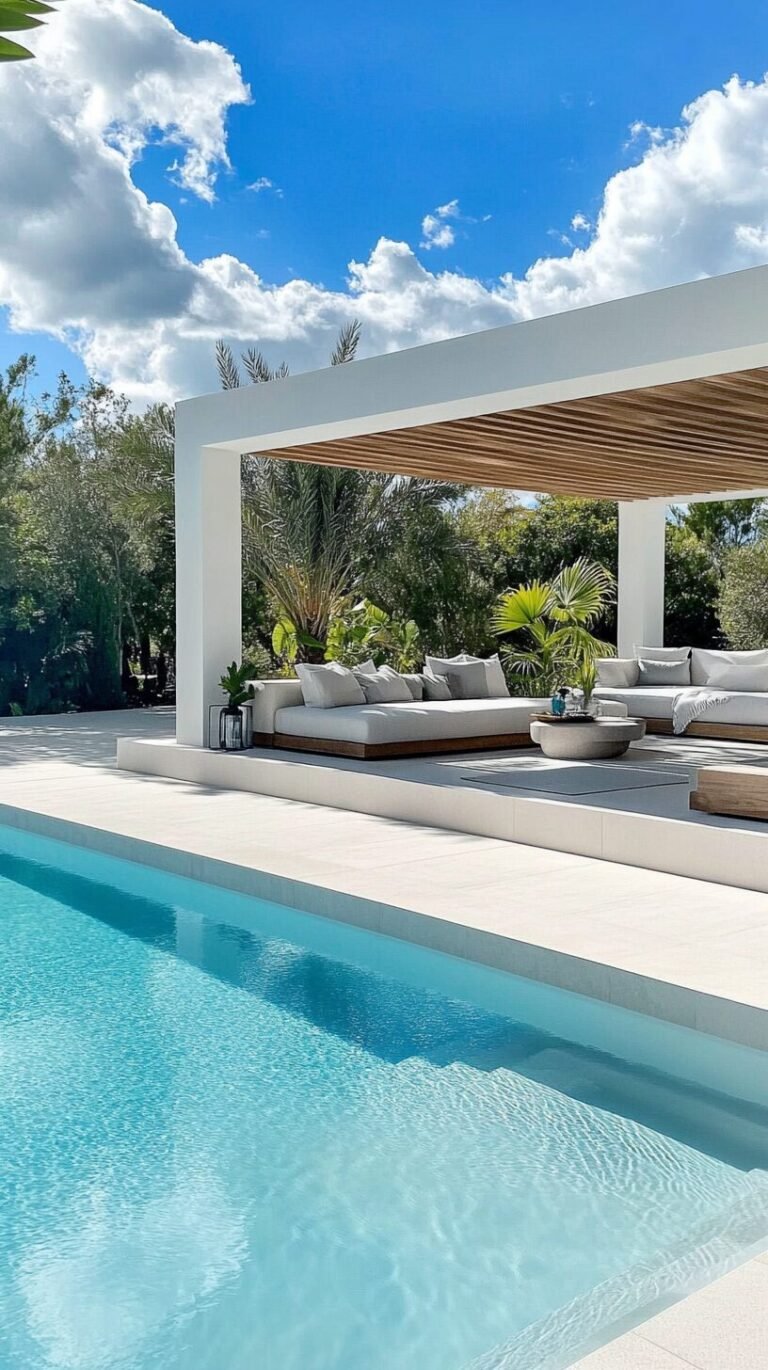
Sanctuary spaces are sheltered spaces. A pergola frames the hot tub area and creates the overhead enclosure that transforms an open yard into a room.
Hang drapes on two sides for privacy. Train climbing roses or wisteria across the roof beams over time. Install dimmable string lights for evenings that feel genuinely different from the rest of the yard.
Cedar or redwood pergolas are particularly well-suited to this — the silvering that comes with weathering gives them an aged, established quality that actually improves the sanctuary atmosphere.
3. Natural Stone Sanctuary Surround
The material surrounding your hot tub determines the emotional register of the entire space.
Natural stone — rough-cut flagstone, dark slate, warm travertine — communicates permanence and earth in a way that tile and composite board simply cannot replicate. Stone has weight. It has presence. It makes a hot tub area feel grounded in a way that lighter materials never achieve.
Use irregular edge cuts rather than uniform shapes. Nature is asymmetrical, and asymmetry is what makes stone surrounds feel genuinely organic rather than manufactured.
4. Minimalist Japanese Soaking Garden
Japanese design philosophy holds that a sanctuary cannot contain excess. Every element must earn its presence.
A cedar soaking tub on raked gravel. bamboo fencing creating a quiet perimeter on two sides. One precisely shaped plant — a dwarf pine, a sculptural bamboo cluster — as the single focal point. Nothing decorative. Nothing redundant.
The restraint is the point. Removing every unnecessary element leaves only the sensation of the soak itself — and that is exactly what a sanctuary should deliver.
5. Elevated Rooftop or Upper-Deck Retreat
Sanctuary exists at a remove from ordinary life. Elevation creates that remove.
A rooftop or second-story deck installation lifts you above the busy plane of the yard — above the garden furniture, the lawn equipment, the visual noise of ground-level living. What replaces it is sky, distance, and the particular quality of light that exists at height.
Before any planning proceeds: have a structural engineer confirm load capacity. A filled tub with four people on board regularly exceeds 3,500 pounds. This single call prevents a catastrophic and costly structural failure.
6. Hillside-Carved Soaking Alcove
A sloped yard offers something flat yards cannot: natural enclosure.
Carve the jacuzzi into the grade so retaining walls rise on two or three sides. Plant the slope above with native grasses or groundcover. The earth surrounds and shelters the soaking space in a way that no constructed wall fully replicates.
The hillside also provides thermal mass. The surrounding soil insulates the installation, stabilizing water temperature and lowering heating costs across every season you use it.
7. Fire and Water Pairing
The oldest human sanctuaries combined fire and water. There is a reason for this that has not changed in ten thousand years.
Place a fire pit close enough to your jacuzzi to feel when you step out of the water. The transition — from heat to cool air to fire warmth — is one of those rare experiences that requires no explanation and leaves no ambivalence.
A gas fire pit gives you control and convenience. Wood-burning gives you the smell and the sound. Both create the atmosphere. The secret is placing them close enough that you can feel both simultaneously.
8. Infinity Edge With Landscape View
A true sanctuary does not end at its walls.
If your property has a view worth sitting in front of, an infinity-edge jacuzzi removes the visual boundary between the tub and the landscape. The water appears to continue into whatever lies beyond — hills, water, forest, cityscape.
The engineering cost is higher than a standard installation. The experiential return is proportionally greater. If the view exists, this is the design that honors it.
9. Living Green Privacy Enclosure
A sanctuary that feels exposed is not a sanctuary. It’s a performance.
Instead of a solid fence that closes the space in and blocks light, install vertical garden panels on a wooden frame. Fill them with trailing plants, ferns, or moss. The living screen provides privacy while keeping the space feeling open and breathing.
As the plants mature, coverage increases. Sound absorption increases. The space becomes progressively more private and more verdant without a single additional design decision.
10. Swim Spa Dual-Zone Unit
A sanctuary built for active recovery and passive soaking requires a unit that delivers both.
A swim spa provides a current zone for swimming or resistance exercise and a separate heated soaking bay with jets. Two distinct experiences, one installation, one fraction of the footprint a pool requires.
For climate zones with genuine cold seasons, the swim spa extends the outdoor wellness season dramatically. You’re soaking in February while the neighbors’ pool sits frozen under a cover.
11. Tropical Immersion Theme
A sanctuary can transport as well as shelter. A tropical theme, fully committed, relocates you.
Tiki torches on bamboo posts. Lava rock accents around the perimeter. Cold-hardy palms or heliconia in containers. A thatch-panel canopy covering the soaking area.
The commitment level determines everything. Halfway tropical looks like a costume. Fully tropical looks like Bali. The line between them is simply the willingness to go all the way.
An outdoor shower with a rainfall head completes the ritual — rinsing under open sky becomes as much a part of the experience as the water itself.
12. Architectural Concrete and Light Design
Some sanctuaries are defined by warmth and texture. Others are defined by precision and clarity.
Poured concrete surround. Matte finish. Color-changing LED lights recessed beneath the rim, directed downward to trace the waterline with a continuous glow after dark.
This is sanctuary as high design — sharp, intentional, cinematic. The absence of ornament is the statement. The space communicates through geometry and light rather than texture and pattern.
13. Forest Clearing Sanctuary
The most ancient experience of sanctuary is the clearing in the woods — a sheltered, enclosed space that feels discovered rather than constructed.
Replicate it in any yard: plant tall ornamental grasses, columnar birches, or dense arborvitae around the hot tub perimeter. Build a decomposed granite path that winds into the space. Let the planting close in until the clearing feels like an interior.
The surrounding green absorbs sound and light, creating an atmosphere that genuinely differs from the rest of the yard. For suburban properties with visual noise on all sides, this approach is transformative.
14. Multi-Tier Landscape Deck
Sanctuary thrives on hierarchy — a sequence of spaces leading from the ordinary to the special.
A tiered deck creates that sequence. Dining and gathering on the upper level. Lounging on the middle. Soaking on the lowest — the most sheltered, most private, most intimate zone.
The descending movement toward the water has psychological weight. It signals a transition. seating on the middle tier provides a decompression zone between the activity of the upper level and the stillness of the tub below.
15. Walled Courtyard Retreat
The walled garden is one of the oldest sanctuary forms in human architecture. If your home provides that geometry — a U or L shape with an interior corner — use it.
The existing walls deliver privacy and wind shelter you couldn’t build more cheaply. Add oversized planters in the corners, outdoor curtains to soften the open side, and candle lanterns at ground level for evening light that reads as intimate rather than functional.
The result is a soaking space that feels genuinely enclosed and private — a world that exists apart from the rest of the property.
16. Bohemian Layered Spa Corner
Sanctuary doesn’t require clean lines and precise geometry. Some of the most restorative spaces are the ones that feel fully inhabited — layered, personal, warm.
Macramé wall hangings on the fence. Handmade tile around the tub base. outdoor rugs overlapping on the deck surface. A wide wooden bench with folded towels and a candle or two.
The textures do the emotional work. Every surface communicates care and intention — the opposite of the sterile, showroom-perfect outdoor spaces that look beautiful in photographs and feel cold in person.
17. All-Weather Gazebo Hot Tub Room
A sanctuary that disappears for five months of the year is not a sanctuary — it’s a summer amenity. A hardtop gazebo removes that limitation entirely.
You can soak when it rains. You can soak in a snowstorm and watch the flakes fall around you. You can add screens for summer evenings and a small radiant heater for deep winter. The experience changes with the seasons rather than ceasing with them.
That seasonal continuity changes how you feel about the space. It becomes genuinely yours, in a way a seasonal amenity never quite does.
18. Spa-to-Pool Spillover Installation
Where a pool already exists, the spa spillover is the sanctuary upgrade that unifies the entire space.
A raised hot tub spilling continuously into the main pool adds the sound of moving water to every moment in the yard — not just while you’re soaking. That sound changes the ambient quality of the space in a way that has to be experienced to be understood.
Hire only a contractor with proven spillover experience. The plumbing design is specific to this application. Errors lead to leaks and pump failures that are difficult and expensive to trace.
19. Gravel-Set Freestanding Tub
Sanctuary does not require construction. Sometimes the most serene spaces are the simplest ones.
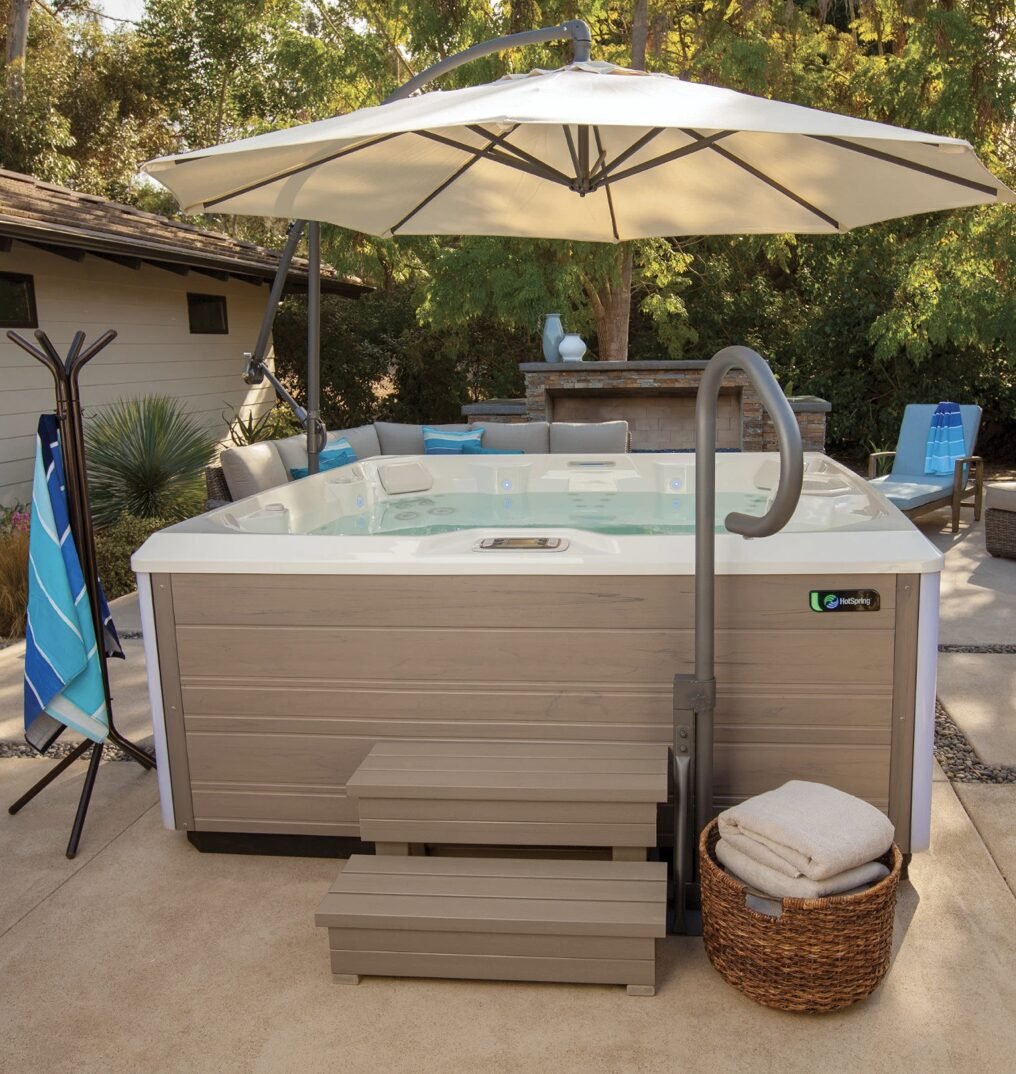
A level gravel pad. A premium freestanding jacuzzi set on it. One carefully chosen plant nearby. A towel hook on the fence. The gravel continues around the tub with clean edges.
No project timeline. No contractors. No construction disruption. Just a quality tub in a setting where restraint reads as sophistication. For renters and those new to the outdoor wellness lifestyle, this is the right entry point.
20. Smart Connected Sanctuary
A sanctuary that requires effort to enter will be used infrequently. App-controlled hot tubs remove every obstacle between you and the water.
Set the temperature from the couch. Schedule the filtration cycle for the middle of the night. Program the lights to shift to a warm setting twenty minutes before you typically soak. Let the tub anticipate your needs rather than requiring you to manage it.
The result is a hot tub you actually use five times a week instead of once on weekends. And a sanctuary that gets visited regularly is worth infinitely more than one that sits covered and neglected.
Four Mistakes That Ruin Sanctuaries Before They Begin
The sanctuary you’re building deserves to last. These four planning failures are the most common reasons it doesn’t.
No drainage plan. A wet area without drainage becomes a mold and algae problem within weeks. Build slope and channel drainage into the design from the beginning, not as a correction after the fact.
No equipment access. The most beautiful installation becomes a liability the moment a pump fails and your contractor says the only way to reach it is demolition. Access panels are a planning requirement, not an optional detail.
Undersized electrical service. Hot tubs demand a dedicated 220–240V GFCI circuit installed by a licensed electrician with specific hot tub experience. This is not a general electrician job, not a handyman job, not a DIY project.
Inadequate foundation. A loaded hot tub is extremely heavy. Grass fails. Unstabilized soil settles unevenly. You need reinforced concrete, rated gravel compaction, or a structurally engineered deck designed explicitly for the load.
Attend to these details and your sanctuary will remain beautiful and functional for ten years or more. Ignore any one of them and you will spend that time managing consequences.
Your Sanctuary Starts With One Decision
You’ve seen twenty ways to build the backyard you’ve been imagining.
Not all twenty will fit your yard. Not all twenty will fit your budget. You don’t need all twenty.
You need one. The one that felt most like yours when you saw it. The one that made you think “that’s actually possible” rather than “maybe someday.”
Build that one.
The distance between the yard you have and the sanctuary you want is a single decision. Make it tonight. Everything else will follow.