30+ Swimming Pool Designs to Inspire Your Backyard Project
Disclosure : This post may contain affiliate links or paid partnerships. I may earn compensation if you click a link or make a purchase, at no additional cost to you. See my disclosure for more info.
Think about what your backyard could become.
A warm Friday evening. The back door opens. The water in your private pool is perfectly still, catching the last glow of a summer sky.
For many homeowners, that scene is entirely achievable. The challenge is navigating the overwhelming volume of pool inspiration online — most of which falls into two unhelpful extremes: unattainably expensive, or forgettably generic.
This guide takes a different approach. You’ll find more than 30 real pool designs — from organic freeform shapes to precision geometry, from compact urban solutions to ambitious architectural statements — all explored with honest commentary on what works and why.
Before the designs, though, a more important topic needs addressing.
The mistakes.
Understanding them first will sharpen every decision you make from this point forward.
What Separates a Pool That Works From One That Disappoints
The most common misconception in pool planning is that the visual outcome is what matters most. Tile selection, shape, water color — these capture attention, but they rarely determine whether a pool succeeds long-term.
What actually matters is whether the pool was designed around the people who will use it — their routines, their household, their specific property.
A pool aligned with your lifestyle adds genuine, lasting value. One designed purely for visual impact often becomes an underused, expensive fixture.
The decisions that determine which outcome you get happen before construction begins.
Common Pool Planning Errors Worth Knowing Before You Start
These are the planning errors that cause the most regret among homeowners after installation. Reading through them now — before any decisions are finalized — is time well spent.
- Overlooking local building codes and permit requirements. Setback rules, fencing requirements, drainage standards, and permit timelines vary significantly by location. Discovering compliance issues after planning begins can delay or derail a project entirely.
- Selecting a design that doesn’t reflect actual usage patterns. An impressive-looking pool that doesn’t serve how the household actually spends time outdoors becomes a maintenance liability. Consider carefully whether the primary use case is lap swimming, social gathering, relaxation, or supervising children — and design accordingly.
- Failing to account for operating costs. The installation cost is only the first financial consideration. Energy for heating, water treatment chemicals, professional cleaning, and insurance adjustments are recurring expenses. Estimating these in advance prevents budget surprises later.
- Underinvesting in filtration equipment. Filtration quality directly determines water clarity. A premium pool with inadequate filtration will experience water quality problems regardless of how well everything else is constructed.
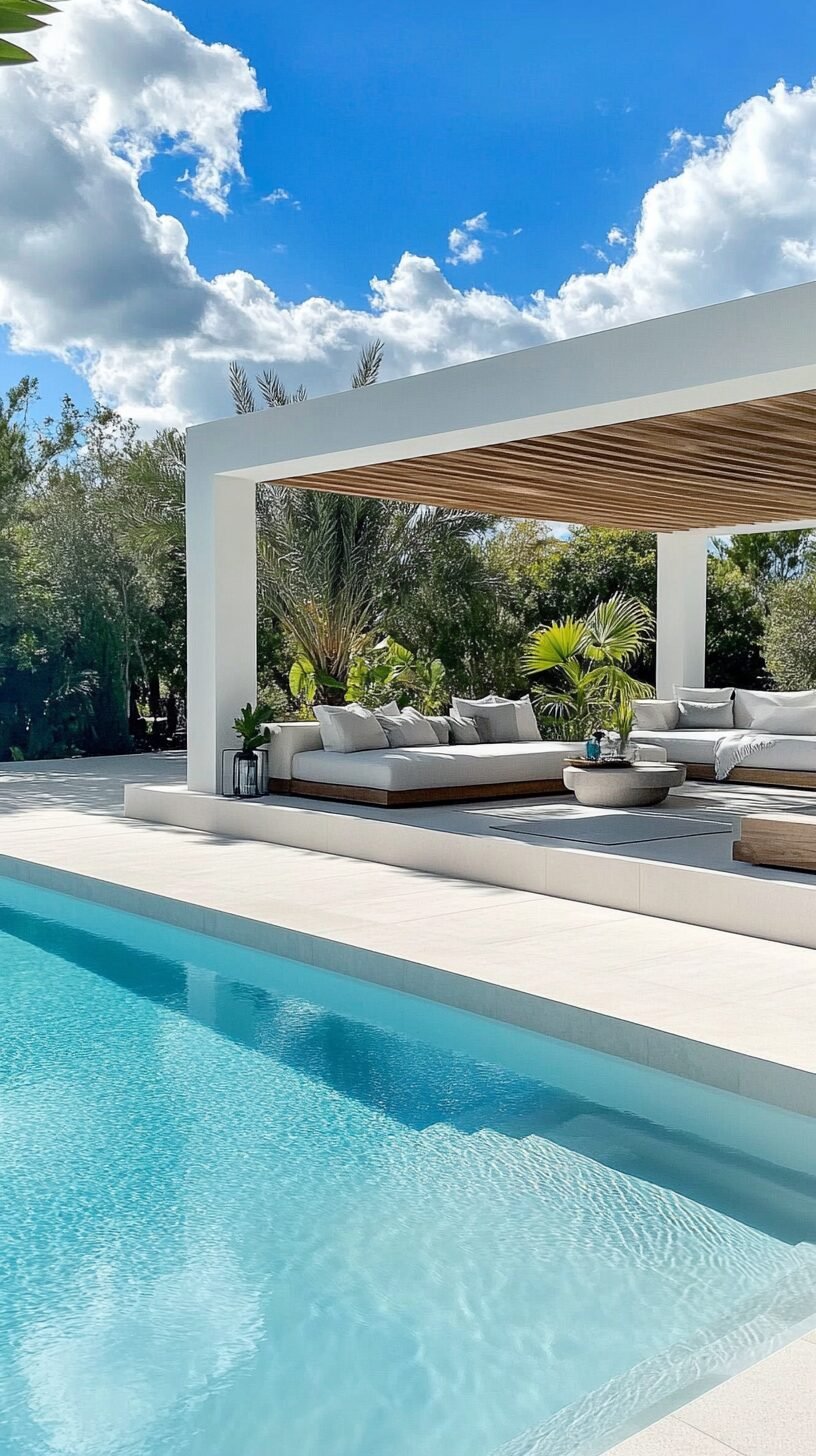
- Omitting shade from the initial design. A fully exposed pool is uncomfortable during peak midday hours. Pergolas, shade sails, and large umbrellas should be planned as integral elements rather than future additions.
With those considerations in view, the design options that follow will be much easier to evaluate objectively.
Freeform Pools — Natural Shapes That Feel Organic and Inviting
1. Kidney-Shaped Pool
One of the most consistently popular residential pool shapes. The gently curved perimeter adapts well to irregular lots and creates a natural, cohesive relationship between the pool and its surroundings.
2. The Lagoon Pool
A curved pool perimeter paired with natural stone detailing and dense tropical vegetation produces the visual impression of a private water feature found in nature rather than constructed in a backyard.
The effect, when well-executed, is genuinely transporting.
3. Zero-Edge Beach Entry
A gradual floor transition from the shallow entry into deeper water replicates the experience of walking into the ocean from a gently sloping beach. Particularly practical for households with young children or elderly swimmers, while delivering strong visual appeal.
4. All-Natural Swimming Pool
Chemical-free water maintenance achieved through aquatic plant biology. The aesthetic resembles a natural pond or swimming hole while remaining entirely functional for regular swimming. An increasingly popular choice for environmentally conscious homeowners.
Geometric Pool Designs — Precision and Contemporary Style
5. The Classic Rectangle
The rectangular pool remains a foundational residential design choice for good reason: clean geometry, efficient use of space, and a timeless aesthetic that integrates with a wide range of architectural styles.
6. The L-Shape
The L-shape configuration creates functionally distinct zones within a single pool — one section suited to active use, another to relaxation. Particularly effective when wrapping around an existing outdoor cooking or dining area.
7. Compact Square Plunge Pool
For properties with limited outdoor space, a square plunge pool in the 10- to 14-foot range provides a genuine aquatic experience without the footprint requirements of a full-size pool.
8. Asymmetric Angular Pool
Pools with non-uniform geometric angles create visual interest that differs from standard rectangular designs. The contrast between sharp angles and surrounding softscape or concrete hardscape tends to produce a notably contemporary aesthetic.
Pool Landscaping That Completes the Overall Design
Pool landscaping functions as the contextual framework for the water feature itself. Without it, even a beautifully constructed pool can feel incomplete or disconnected from the broader property.
9. Tropical Layers
Palms, bird of paradise, and broad-leafed tropical plants arranged in layered tiers can transform the immediate pool environment into something that reads as genuinely immersive and exotic — where climate permits.
10. Desert-Contemporary Planting
Succulent plantings, gravel mulch, and drought-tolerant ornamental grasses offer a landscape solution that is both visually compelling and resource-efficient. Particularly effective alongside geometric pool designs in arid or semi-arid climates.
11. Privacy Hedges and Vertical Greenery
Bamboo screening, dense hedge plantings, or modular living wall systems create visual privacy without the enclosed feeling associated with solid fencing. They also contribute meaningful textural interest to the overall design.
12. Ornamental Grasses as Pool Borders
Ornamental grasses require minimal upkeep, produce no significant leaf debris, and provide gentle movement in light wind. A practical and aesthetically effective edging choice for most pool styles.
Pool Designs for Smaller Backyards
Smaller properties do not preclude meaningful pool installations. In many cases, spatial constraints produce more refined and intentional designs than unrestricted sites allow.
13. Cocktail Pool
A cocktail pool — typically 10 by 12 feet or similar — provides adequate water depth for soaking and social use while fitting within lot sizes that would not support a conventional pool. Designed primarily for recreation and relaxation rather than serious swimming.
14. The Enclosed Courtyard Pool
An enclosed or semi-enclosed pool space, defined by walls or plantings on multiple sides and finished with overhead lighting and container planting, creates an intimate and self-contained outdoor environment. Particularly effective in urban or semi-urban settings.
15. The Spool (Spa-Pool Hybrid)
The spa-pool hybrid — sometimes called a spool — combines hydrotherapy jet functionality with conventional pool cooling capacity. A single compact unit that provides utility across all seasons.
16. Shipping Container Pool
Repurposed shipping containers converted into above-ground pool structures have become a recognized design option. Installation timelines are shorter than conventional in-ground construction, unit costs are typically lower, and the structures are relocatable.
Infinity Edge and Overflow Pool Designs
17. Classic Infinity Edge
The vanishing edge design creates the visual impression of the water extending to meet the landscape or horizon beyond the pool boundary. Most effective on elevated sites or properties with a distinct view worth framing.
18. Perimeter Overflow
In a perimeter overflow configuration, water flows continuously over all four edges into concealed collection channels, leaving the pool surface flush with the surrounding deck. The result is a notably calm, mirror-like water surface.
19. Raised Spa Cascading Into an Infinity Pool
A raised spa positioned to cascade water into the main pool below combines two distinct aquatic zones in a single design composition. Both elements function independently while contributing to a unified visual and acoustic experience.
Pool Features and Upgrades Worth Considering
The base pool design establishes the foundation. Feature selections determine the depth and range of the experience it delivers.
20. Fire Bowls at the Water’s Edge
Fire features positioned at the water’s edge introduce a visual dynamic that changes substantially after dark, as flame and water reflections interact. The contrast between heat source and water creates a distinctive atmospheric quality.
21. Tanning Ledge
A tanning ledge — a shallow shelf approximately six inches below the water surface — accommodates in-water lounging chairs and represents one of the most consistently requested features in contemporary residential pool design.
22. Swim-Up Bar
A swim-up bar integrates submerged seating with a counter positioned at water level, allowing occupants to remain in the pool while using the bar surface. A feature that tends to generate significant use once installed.
23. Underwater LED Color Lighting
Submersible LED lighting systems represent one of the most cost-effective pool upgrades relative to visual impact. The transformation in the pool’s appearance after dark is substantial.
24. Hidden Grottos
A grotto configuration — a concealed alcove accessible by swimming beneath a waterfall structure — adds an element of spatial discovery to the pool environment. Popular with children and often more appreciated by adults than they initially expect.
Pool Deck and Coping Material Options
Deck and coping material selection significantly influences both the functional performance and the visual character of a pool. This aspect of the design merits the same consideration given to the pool itself.
25. Travertine Pavers
Travertine maintains a lower surface temperature in direct sun than many alternatives, is naturally slip-resistant when finished appropriately, and offers tonal variation that produces a refined, classical appearance compatible with most architectural styles.
26. Hardwood Deck
Dense hardwoods such as ipe or teak offer warmth underfoot, visual richness, and a material character that develops appropriately with age. Regular maintenance is required to preserve the appearance over time.
27. Poured Concrete with Brushed Texture
Poured and textured concrete provides maximum flexibility in terms of color, surface treatment, and form. It integrates effectively with nearly every architectural and landscape design approach.
28. Natural Stone Coping
Natural stone coping options such as bluestone or limestone introduce material depth and craftsmanship detail that distinguish a well-considered pool design from a standard residential installation.
Distinctive Pool Designs for Ambitious Builds
For projects where conventional options are insufficient, the following designs represent what becomes possible when conventional constraints are set aside.
29. Rooftop Pool
A rooftop pool installation converts underutilized building surface area into a functional aquatic space with elevated views. Common in urban multifamily and residential contexts where grade-level outdoor space is unavailable.
30. Glass-Walled Pool
Glass-walled pools use structural acrylic panels to make the pool interior visible from adjacent spaces. The result is an architectural element that functions simultaneously as water feature, lighting source, and visual focal point.
31. Multi-Level Pool With Cascading Water
Multi-level pool configurations use grade changes and water features to create a sequence of connected aquatic zones, each serving a distinct purpose. The engineering complexity is significant, and the visual and experiential result is correspondingly distinctive.
32. Dark-Bottom Finish
Dark pool finishes — achieved through deep plaster or dark-toned tile — produce water that appears considerably deeper and more naturalistic than standard pale interiors. The dark surface also provides passive solar heating benefits.
33. Transparent-Bottom Pool
A pool constructed with a transparent floor panel over a habitable space below allows light to pass through the water into the room beneath. An extreme technical and design achievement with a correspondingly dramatic effect.
Turning Inspiration Into a Real Plan
More than 30 pool designs have been covered here — ranging across shape, scale, feature set, material choice, and landscaping approach — along with the planning errors that most frequently undermine otherwise well-intentioned projects.
Some of these options have likely resonated with your existing vision. Others will have clarified what you’re not looking for — which is genuinely useful information when making significant investment decisions.
The most important principle remains consistent across every design category:
The pool that serves you best is not the most impressive or the most expensive. It’s the one designed specifically for your site, your household’s patterns, and your long-term expectations for how outdoor space should function.
Begin with shape. Add features that genuinely match how you plan to use the space. Select materials suited to your climate and maintenance commitment. Then approach landscaping as a design element rather than an afterthought.
Do not rush the planning phase.
A well-planned pool does not merely add a water feature to your property. It fundamentally changes the way you experience your own home — every day you live there.
Return to this guide as needed. Share it with anyone involved in the planning process.
The project you’re imagining is more achievable than it probably seems right now.