How to Make a Futon Look Good in Your Living Room (Designer Secrets Revealed)
Disclosure : This post may contain affiliate links or paid partnerships. I may earn compensation if you click a link or make a purchase, at no additional cost to you. See my disclosure for more info.
So you got a futon.
Maybe the budget made the decision for you. Maybe square footage is at a premium. Maybe you simply needed seating — and fast.
Now it’s sitting in your living room and you can’t quite figure out why it doesn’t look right.
You’ve scrolled through Pinterest looking for inspiration. You’ve studied perfectly curated Instagram living rooms. But yours still has that unmistakable “temporary housing” energy.
You’ve shifted it around. Tossed a blanket across the cushions. Propped up an extra pillow or two.
Nope.
The nagging thought creeps in: maybe the futon itself is the issue. Maybe you should have saved up for a proper sofa. Maybe you just have to live with it looking mediocre.
Wrong on all counts.
The futon is fine. What’s missing is intentional styling.
Professional designers aren’t working with furniture you can’t afford or find. They shop the same stores, deal with the same constraints, and sometimes work with nearly identical pieces.
Their advantage is a framework. A disciplined approach to space, proportion, layering, and light that makes any furniture — even a basic futon — read as a conscious, confident choice.
This article hands you that framework.
No filler tips. No impractical advice. Just concrete steps you can act on today to transform how your futon looks in your living room.
Here we go.
1) Rethink Where the Futon Lives in the Room
The first mistake people make is also the most common.
They push the futon flush against the wall, laid flat, wide, like a cot waiting to be used. The visual message is “I couldn’t figure out where else to put this.”
Skilled designers see furniture as spatial architecture. Every piece shapes the room it’s in.
Move your futon a few inches forward from the wall. Even a small gap creates a shadow behind it that gives the piece visual weight and makes it feel deliberately placed rather than abandoned in place.
Got a futon with an exposed frame? Give it room. A frame crowded into a corner disappears. Shown off with breathing room, it becomes part of the design.
2) Ground It With a Properly Sized Rug
Without a rug beneath it, a futon floats. With an undersized rug, it looks even more out of place.
The designer’s rule: the rug must be big enough for at least the front legs of the futon to rest on top of it.
Better still, have the rug extend past both sides of the futon and well in front of it. This carves out a defined seating zone and signals to anyone entering the room that this space was arranged with intention.
A jute rug delivers natural warmth without competing for attention. A flat-weave rug adds a layer of texture that stays visually quiet.
Skip the rug and you skip the single easiest upgrade available to you. Don’t skip it.
3) Stop Throwing the Blanket — Try This Instead
Yes, you’ve tried the draped throw. It looked good for about forty minutes.
Then it slid. Bunched. Ended up in a heap.
Try this approach instead.
Fold the throw lengthwise into a neat, narrow panel — roughly one-third the futon’s width. Drape it over just one armrest, letting it fall down the side. Off-center. Not centered, not spread across the seat. Intentionally asymmetrical.
Asymmetry is one of a designer’s most useful tools. Symmetry signals “staged.” Asymmetry signals “someone with good taste lives here.”
Pick a throw with contrasting texture to your futon’s upholstery. Smooth fabric futon? Reach for a chunky knit or a linen throw. That textural contrast is doing more visual work than you might realize.
4) Arrange Pillows Like a Designer, Not a Shopkeeper
A futon drowning in identical pillows looks like a mattress showroom. A futon with two lonely cushions looks neglected.
The designer’s range: three to five pillows total. Odd numbers read more natural and relaxed.
Work in layers. Two large pillows against the back at each armrest. One or two medium pillows overlapping them in front. One small accent pillow, placed off-center, not directly in the middle.
Vary textures. A velvet pillow paired with something woven. A block color beside a subtle geometric print.
The real upgrade is mixing shapes. Break the row of squares by working in a lumbar pillow — a horizontal rectangle. It disrupts the predictable lineup and makes the whole arrangement feel collected rather than purchased as a set.
5) A Side Table Changes Everything
A futon with no side table is a sentence that trails off without ending.
Something feels missing. Because something is.
The side table doesn’t need to be expensive or special. A round side table works beautifully against the straight lines of most futon frames — the circle-versus-rectangle contrast is a classic design move. A wooden stool is a budget-friendly alternative that works just as well.
Height matters: aim to match the armrest. Even with the armrest, the table becomes a natural extension of the seating, not an add-on.
Keep the table surface simple: a small lamp, a candle, and one additional object. Three items. That’s your composed vignette — a small stage set that brings the space to life.
6) Lighting Is the Invisible Force Behind Every Good Room
Follow every step in this guide and the result will still fall short if the lighting is wrong.
Overhead fixtures — the ones your landlord installed — produce flat, even light with no shadows. That kind of light washes out character and makes any room feel generic.
Bring in a floor lamp near the futon. Use a warm bulb — 2700K is the sweet spot, producing that amber, welcoming glow that reads as “designed.”
Then add a second source across the room. A table lamp on a surface. Warm string lights along a shelf. Multiple layers of light at different heights create depth, shadow, and dimension that a single overhead fixture can never provide.
Designers never rely on one light source. Now you understand exactly why.
7) Treat the Wall Behind the Futon as Part of the Composition
The wall directly behind your futon doesn’t just sit there. It participates in the design.
Leave it bare and the futon feels unfinished — like a focal point that the room forgot to support.
The simplest solution: one substantial piece of art, hung centered above the futon, with the visual midpoint at standing eye level. One of the most repeated mistakes in home decorating is hanging art too high — resist that impulse.
Alternatively, build a gallery cluster of three to five pieces, varying sizes, keeping the full grouping within the futon’s width. Never wider than the furniture below. That’s a guideline designers follow consistently.
A third option: a large round mirror. It bounces light around the room, makes the space read larger, and gives the wall weight without competing with the futon for attention.
Choose one and commit to it.
8) Leave Room for People to Actually Move
Designers plan for circulation before they plan for beauty. If the room doesn’t function, no amount of styling can rescue it.
If walking past your futon requires turning sideways, the room will always feel cramped no matter what else you do.
Allow at least 18 inches of clear walking space along the main path. If you’re working with a tight room, try angling the futon slightly rather than running it parallel to the wall. A small angle opens up sightlines and makes the room breathe.
A futon that fits its room gracefully looks purposeful. One that obstructs movement just looks like it got stuck there.
9) Use a Plant to Break the Horizontal
A futon is a long, low, horizontal object. So is most living room furniture. Without a counterpoint, a room full of horizontal lines feels heavy and static.
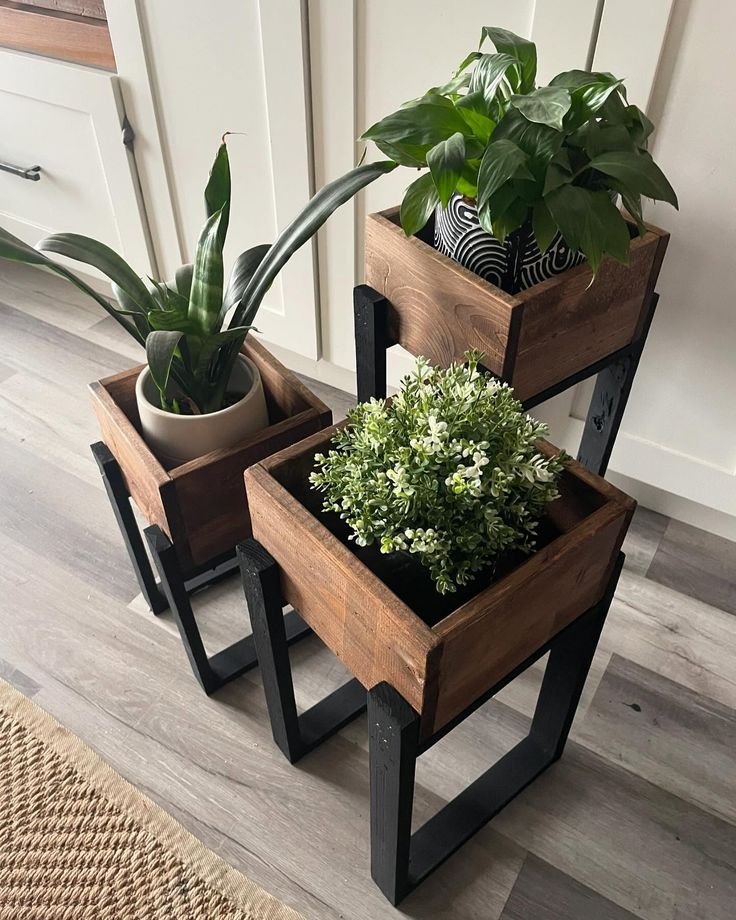
Plants solve this. A tall plant placed beside the futon — a fiddle leaf fig, a dracaena, a snake plant — pulls the eye upward and introduces a vertical line that activates the whole room.
Position it on whichever side of the futon feels emptier. Often that’s the side that doesn’t have a side table, or the corner where the futon meets the wall.
One tall plant is enough. The goal is visual balance, not a garden centre.
Low natural light? A high-quality faux plant delivers the same vertical energy with zero maintenance.
10) Commit to a Three-Color Palette
This is the error that quietly undermines most home styling attempts — and it’s almost invisible until someone points it out.
Gray futon. Teal cushions. Mustard throw. Burgundy rug. Multi-colored artwork. The eye keeps moving and never lands anywhere.
Designers build rooms around a controlled palette. Three colors. Maximum.
One dominant — the futon upholstery and rug. One supporting — pillows and throw. One accent — a single object or artwork that adds a pop.
That’s the entire system.
When the color logic is tight, affordable pieces look considered and deliberate. When it’s loose, even expensive pieces start looking random.
11) Nail the Distance Between the Futon and the Coffee Table
Furniture spacing is one of those details that most people never consciously notice — and yet it’s responsible for how “right” a room feels.
Too much distance between your futon and the table in front of it, and the seating group feels like it’s dissolving. Too little, and the room feels like an obstacle course.
The target is fourteen to eighteen inches between the front edge of the seat cushion and the nearest edge of the table.
The coffee table itself should be roughly two-thirds the length of the futon. Shorter and it looks like a toy beside it. Longer and it takes over the room.
Want to skip the traditional table? Use two small nesting tables or place a round ottoman with a tray with a tray on top. Both are futon-friendly — easy to push aside when the futon unfolds.
12) Plan for the Bed Position From the Start
Most futon styling guides focus entirely on the sofa configuration. And then you have a guest arriving and suddenly everything falls apart.
Think through the unfolded position before you finalize your furniture layout.
Is there enough floor space in front for the futon to fully extend? Is the coffee table light enough to move quickly? If the answers are no, adjust the layout now rather than wrestling with it when you need the bed.
Keep an attractive basket or bin within reach where pillows and the throw blanket can land when the futon converts. It prevents the collapse-of-all-your-styling-in-thirty-seconds scenario.
A futon that looks polished and converts without chaos is the whole point. Don’t design for just one mode.
Your Futon Was Never the Issue
Let’s be direct about this.
Nothing about the futon you bought is holding your living room back. The gap between where you are and where you want to be is purely a question of how the piece is styled and integrated into the space.
Every principle in this guide comes from the same playbook professionals use: proportion, layering, light management, color discipline, spatial flow.
None of it is expensive. None of it requires replacing what you have.
A rug. A considered throw. The right pillows. A lamp. One plant. A deliberate plan. That’s the complete toolkit.
Pick the tip that hit closest to your current situation. Act on it today. Then come back for the next one.
Your living room will surprise you.
You’ll surprise yourself.
Now go style that futon.