30+ Farmhouse Kitchen Ideas That Make Every Morning Feel Like Coming Home
Disclosure : This post may contain affiliate links or paid partnerships. I may earn compensation if you click a link or make a purchase, at no additional cost to you. See my disclosure for more info.
There’s a certain kind of kitchen that pulls you in the moment you walk through the door.
Not because it was expensive. Not because it’s perfectly coordinated. But because it feels like it was put together by someone who actually lives there.
That’s the farmhouse kitchen at its best: honest materials, meaningful layers, and a warmth that no amount of staging can fake.
The good news is that you don’t need a full renovation to get there.
You need over 30 well-chosen moves. Here they are.
The Soft Layer: Textiles That Change the Room’s Whole Mood
1. Switch to soft linen curtain panels.
The window treatment does more work than most people realize. Simple linen curtains in warm white or natural linen let sunlight diffuse through the room instead of flooding or blocking it — and the way they move when the window’s open is quietly beautiful.
2. Put a faded-style runner on your kitchen floor.
A worn-looking runner rug in muted tones softens the hardness of tile and adds warmth underfoot in the places you stand most. It’s one of the simplest upgrades that immediately transforms how a kitchen feels to use.
3. Make the switch from paper to cloth napkins.
Roll cloth ones and tuck them into a basket on the counter. The ritual of setting the table shifts when the napkins are something real. It turns even a weeknight dinner into something that matters.
Finishing Touches That Carry More Weight Than They Look Like They Should
4. Add one or two small plants — and stop there.
A potted herb or a trailing plant on a shelf is exactly right for farmhouse style. More than two starts to feel like a greenhouse. Restraint is the secret ingredient.
5. Stand a few wooden cutting boards against the backsplash.
Different sizes, different wood tones, different shapes. Cutting boards used as decor are the most honest objects in the room — pretty because they’re functional, not despite it.
6. Tuck the trash can out of sight inside a cabinet.
A pull-out cabinet for the bin removes one of the kitchen’s most persistent visual distractions. What disappears makes the rest of the room look better.
7. Rest a cast iron skillet on the stove as a matter of habit.
A cast iron skillet sitting on the burner tells the story of a kitchen that gets used. It’s the most effortlessly farmhouse object you can own — and it makes every breakfast better.
8. Keep a small wooden step stool somewhere accessible.
A wooden step stool is practical enough to earn its spot and charming enough to improve any corner it occupies. In farmhouse style, things that work hard are always worth keeping visible.
The Building Blocks: Structural Choices That Anchor Everything Else
9. Center the kitchen around a deep farmhouse sink.
A generously proportioned apron-front farmhouse sink in fireclay or cast iron is the single element that most decisively transforms a kitchen into a farmhouse kitchen. Everything else works around it.
10. Paint the cabinets a warm, creamy off-white.
Avoid anything with a blue or gray undertone. Farmhouse white sits in the territory of cream, bone, and bleached linen. The warmth in the paint is what makes the space feel inviting rather than clinical.
11. Bring butcher block into at least one section of countertop.
The island, a prep area, a stretch near the range — maple or walnut adds instant warmth. It also develops character as it ages, which is the whole point of farmhouse materials.
12. Dress the island face in beadboard.
A weekend project with paint and a few panels. The texture it adds to an otherwise flat surface reads immediately as farmhouse — and it cost far less than replacing anything.
13. Use subway tile for the backsplash in a tone that’s yours.
The traditional shape says country kitchen. A personal color — sage, warm gray, faded blue — makes it feel chosen rather than defaulted to. Both things matter.
Island Living: Making Your Island the Room’s Natural Center
14. Choose an island that looks like furniture, not cabinetry.
Turned legs. A slightly distressed or painted finish that contrasts with the surrounding kitchen. A furniture-style island looks like it wandered in from somewhere else and decided to stay.
15. Dress the island surface with objects that prove it works hard.
A cutting board leaning against the backsplash. A container of wooden spoons. A towel casually folded over the edge. These aren’t decorations. They’re evidence of a kitchen that actually cooks.
16. Bring in seating that doesn’t all match.
A set of identical stools looks like it came out of a box. A gathered mix of different styles and materials looks like a kitchen with a story. The difference is significant.
The Quiet Power of Getting the Details Right
17. Update the cabinet hardware to something with real visual weight.
Bin pulls. Bin pulls. Cup pulls. Solid knobs in matte black or aged bronze. The hardware is the jewelry of the kitchen — small, but it changes how the whole outfit reads.
18. Hang a substantial metal pendant over the sink or island.
Steel. Iron. Something matte, something heavy, something that looks like it belongs in a working kitchen rather than a catalog. A metal pendant light should have presence without being showy.
19. Install a bridge-style kitchen faucet.
The visible arc connecting two separate handles is a small detail that says a lot. Replacing your faucet with a bridge-style model is one of the most effective single-item upgrades available in a farmhouse kitchen.
20. Screw a row of iron hooks under the upper cabinets.
For mugs. For dish towels. For the cooking tools that always end up somewhere inconvenient. Hooks are the farmhouse answer to storage — visible, accessible, beautiful.
Order That Still Feels Lived In
21. Pull out everyday dishes and put them on display.
A wall-mounted plate rack with real ironstone or hand-thrown stoneware is better decor than anything you’d buy specifically for decoration. Use what you love. Show what you use.
22. Organize loose countertop items in woven baskets.
Produce. Bread. Anything that tends to scatter. A woven basket contains the scatter and adds natural texture at the same time — two problems solved with one beautiful object.
23. Mount a pegboard for your most-used cookware.
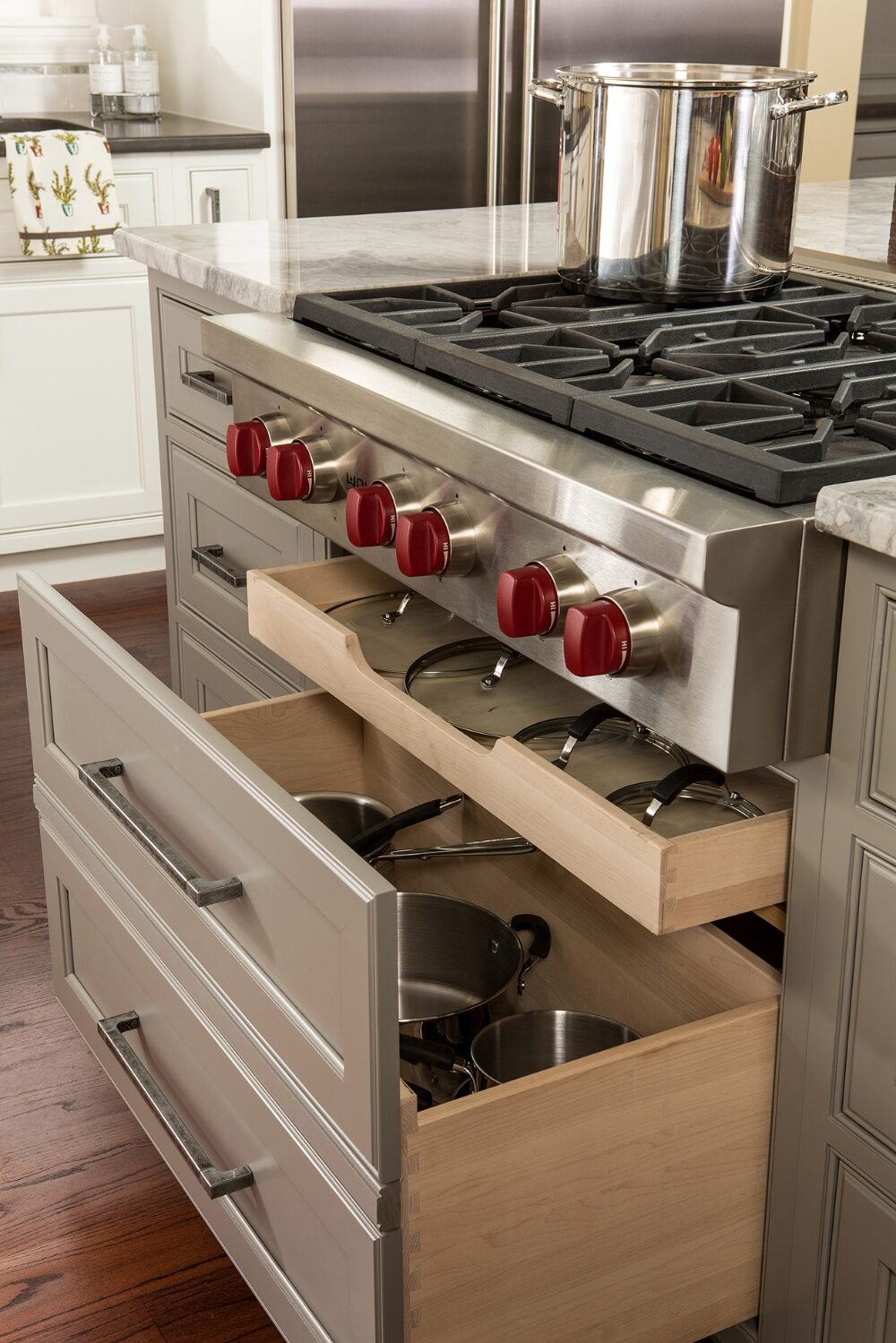
Painted to match the wall, with hooks fitted for pots, pans, and lids. It’s a solution rooted in old farmhouse practicality: keep what you use within reach, and let it be seen.
24. Move pantry staples into glass jars with simple labels.
Flour, sugar, oats, rice — lined up in matching glass jars on a shelf. The uniformity creates calm where there would otherwise be visual noise from mismatched packaging.
Texture and Depth: Building Character into the Walls
25. Remove a few upper cabinets and replace them with open shelves.
Open shelves lighten the room and give you somewhere to display what matters. Style them with space between things. Breathing room is visual rest.
26. Panel one wall in shiplap — usually behind the stove.
Painted the same color as or slightly lighter than the cabinets. It adds texture without volume, presence without dominance. Shiplap works best when it doesn’t call attention to itself.
27. Add ceiling beams for instant age and structure.
Reclaimed wood is the traditional choice. Well-made faux beams deliver the look at a fraction of the cost. Either way, they make a kitchen feel like it was built to last — which is the whole farmhouse story.
28. Panel the lower wall in board-and-batten.
Floor to chair-rail height. White or warm gray. It adds architectural detail to rooms that might otherwise feel too plain, especially in kitchen-dining combinations.
29. Choose one wall for an earthy accent tone.
Dusty sage. Warm clay. Faded linen blue. A single grounding wall gives a room that was all-white somewhere to rest. Warmth and depth come from contrast, not from matching everything.
The Kitchen Table: Where the Day Begins and Ends
30. Build a corner bench into an underused wall nook.
Add cushions and a wood table. Install some hooks above it for bags and coats. That corner becomes the most-used spot in the house — the place where mornings start and evenings wind down.
31. Choose a round, vintage-feeling clock for the wall.
A round enamel wall clock in a dining area tells time and sets tone in equal measure. It says this kitchen isn’t in a hurry. That there’s room here to sit and stay a while.
32. Keep a wooden tray as a permanent table centerpiece.
A candle. A small vase. Salt and pepper. The wooden tray lives there always, gathering seasonal touches as they come. It makes the table feel complete even when nothing’s happening around it.
A Lived-In Kitchen Is Always a Work in Progress
The kitchens that feel the most like home are rarely the ones that were designed all at once.
They grew. Objects came in gradually, things stayed because they were loved, and the room settled into itself over time.
That’s the process. Not a makeover — a slow accumulation of good choices.
Start with one. Let it sit. Add another when you’re ready.
One morning soon, you’ll realize the kitchen has finally caught up to the one you always imagined living in.
That’s the whole point of doing this slowly. It gets to be real.