10 Proven Kitchen Table Decor Tips to Transform Your Dining Space
Disclosure : This post may contain affiliate links or paid partnerships. I may earn compensation if you click a link or make a purchase, at no additional cost to you. See my disclosure for more info.
Your kitchen table sees more of your life than almost any other surface in your home.
Breakfast before work. Dinner with your family. Late-night conversations over a glass of wine. Weekend mornings with nowhere to be.
Yet for most people, the table itself gets almost no attention.
A stray piece of mail here. An abandoned coffee cup there. A centerpiece that’s been sitting in the same spot since last year.
It doesn’t have to be this way.
These ten practical tips will show you exactly how to style your kitchen table in a way that feels elevated, personal, and easy to maintain.
No design degree needed. No enormous budget required.
Let’s get to it.
The Hidden Reason Your Kitchen Table Looks Unfinished
Most kitchen table styling fails at the very first step: intent.
Objects end up on the table because they had nowhere else to go, or because someone assumed that’s what you’re supposed to put there. A fruit bowl that never has fruit in it. A candle that’s never been lit. A vase from two owners ago.
None of it was chosen. It just accumulated.
Here’s the mindset shift that changes everything: every single item on your kitchen table should be there on purpose. It should earn its place through beauty, function, or ideally both.
Anything that doesn’t meet that standard is clutter — and clutter is the enemy of good design.
Start by clearing the table completely. Then bring items back one at a time with balance, proportion, and intention as your filters.
Now here’s how to build it back up the right way.
1. Keep Your Centerpiece Conversation-Friendly
The cardinal rule of kitchen table centerpieces: low is almost always better than tall.
A towering floral arrangement might look stunning in an editorial photo. In daily life, it blocks sightlines, gets knocked over, and makes passing dishes awkward.
The most effective centerpieces are modest in scale and high in character.
A wooden dough bowl with seasonal fillings works year-round. A cluster of three pillar candles at varied heights feels warm without being showy. A living potted herb adds color, texture, and a pleasant scent that travels across the room.
Test it simply: sit down at the table and check whether you can make eye contact with someone across from you. If something’s blocking the view, it’s too big.
Low, considered, purposeful. That’s the winning formula.
2. Ground Your Arrangement With a Table Runner
Placing decor items directly on a bare tabletop is one of the most common mistakes in kitchen styling.
Without something beneath them, objects float. They look like they were set down temporarily rather than placed deliberately.
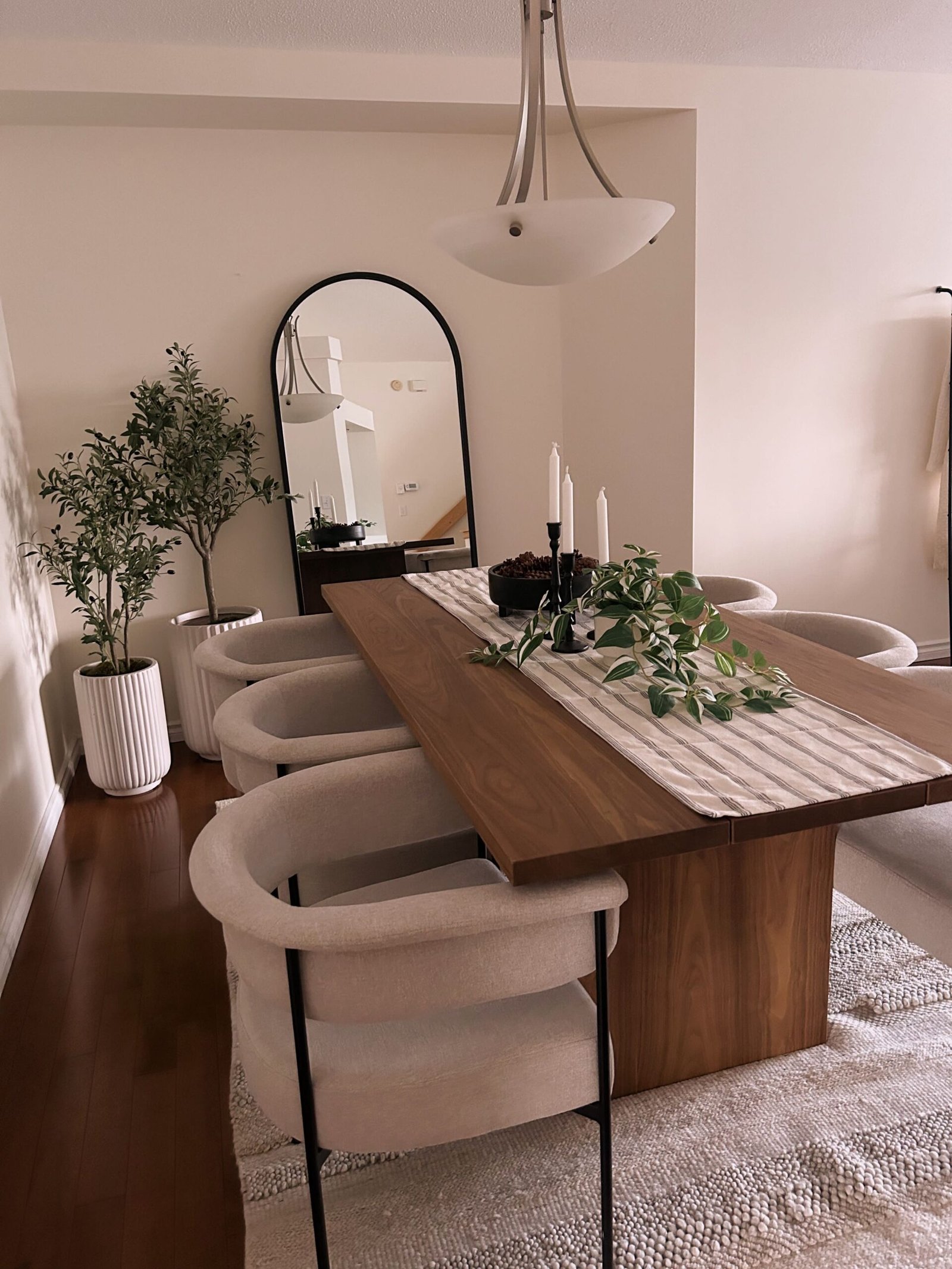
A table runner gives your arrangement a visual spine. It connects everything along the center of the table, adds color and texture, and instantly makes the table look more deliberately styled.
Linen is a classic choice that adapts to nearly any kitchen aesthetic. Jute or burlap works beautifully in relaxed, organic spaces. Macramé adds handcrafted texture with bohemian flair.
For maximum impact, contrast the runner tone with your table’s finish. A pale runner on a dark surface. A richer tone against light wood.
The result is immediate and significant.
3. Always Arrange in Odd Numbers
Professional interior stylists rely on this principle constantly, and it’s almost never explained to the rest of us.
Odd numbers of objects — three, five, seven — are more visually dynamic than even groupings. The human eye takes longer to resolve an odd group, which means it lingers. It stays engaged. The arrangement feels interesting rather than settled.
Even groupings, by contrast, feel symmetrical and resolved. Your eye processes them quickly and moves on.
In practice: three candles of varying heights feel like a deliberate vignette. Two candles side by side look like they were placed without thought. A tall vase flanked by two shorter items creates tension and movement. Four matching objects in a row looks like merchandise.
Group in threes. Vary the heights. Trust the result.
4. Add Candles for Instant Warmth and Atmosphere
Few additions transform a kitchen table as quickly or as affordably as candles.
The key is quality over quantity. One well-chosen candle does more for a table than six bad ones.
Natural beeswax tapers in brass or ceramic holders bring understated elegance to any kitchen. Pillar candles grouped on a tray or wooden board have a grounded, substantive presence. And if open flames aren’t practical for your home, flameless LED candles have improved to the point where even design-savvy guests won’t immediately notice the difference.
Lit candles at the dinner table make an ordinary evening feel considered. That’s worth something — especially on the nights when everything else feels relentless.
Use candles daily. Not just for company.
5. Bring the Outdoors In With Free, Fresh Greenery
The florist is optional. The outdoors is not.
A handful of branches from the yard, a sprig of garden herbs, a bundle of wildflowers from the roadside — arranged in a simple glass vessel or a ceramic pitcher — will outperform almost any store-bought arrangement at a fraction of the cost.
Plants and greenery bring life into a room in a way that no manufactured item can match. The colors are layered. The shapes are organic. The textures shift in the light.
Tie your table decor to the season: dried wheat and autumn leaves in October, pine and holly in December, tulips and ranunculus in spring, dahlias and sunflowers in summer.
If maintaining fresh greenery isn’t realistic, invest in premium faux stems — the kind that require a second look to identify as artificial. Avoid plastic-looking options; they drain the sophistication from any arrangement.
6. Use a Tray to Organize and Elevate
A tray is the closest thing decorating has to a cheat code.
Place a round wooden or woven tray on your table. Set a candle, a small potted plant, and a ceramic salt and pepper set inside it. That’s a styled vignette — full stop.
Without the tray, those exact same items scattered around would look like they’d been left behind by mistake. The tray provides context and containment. It communicates that the grouping was deliberate.
Match the tray to your kitchen’s personality: woven seagrass for casual spaces, marble or stone for modern kitchens, warm-toned wood for farmhouse or transitional styles.
One tray. Three objects. A table that looks professionally styled.
7. Make Placemats and Chargers Part of Your Daily Routine
Pull out your placemats for guests. Put them back in the drawer the rest of the time.
Sound familiar? If so, you’re robbing yourself of an easy daily upgrade.
Laying placemats before each meal — even casual ones — creates a sense of occasion that makes the whole table feel more intentional. You’re sending yourself a quiet message: this meal, this moment, is worth setting properly.
Rattan or woven placemats bring natural warmth. Linen is quietly elegant. Leather or vinyl works well for households that need something easy to wipe clean.
Charger plates underneath your everyday dishes add a layer of visual depth that makes even simple dinnerware look intentional and composed.
It takes under a minute to set. The effect lasts the entire meal.
8. Rotate Your Decor With the Seasons
The number one reason a well-styled table starts to look tired: nothing ever changes.
You put it together once, admired it, and then let it sit untouched. Six months later the candle is a stub, the dried flowers are dusty, and the whole arrangement has that “I gave up” energy.
The fix is not a complete overhaul. It’s small seasonal rotations.
Autumn brings opportunities for warm-toned textiles, dried botanicals, gourds, and amber-hued accents. Winter calls for evergreens, dark berries, and rich, cozy fabrics. Spring is for fresh florals, lighter linens, and pastel or green accents. Summer works beautifully with citrus, coastal textures, and bright pops of color.
Keep a dedicated box for your seasonal table decor. Every few months, swap it out. Twenty minutes of work, and your kitchen feels entirely different.
Your table should feel alive. That requires a little movement.
9. Switch to Cloth Napkins for an Instant Upgrade
This is a small change with a disproportionately large visual impact.
Paper napkins, even nice ones, communicate that the table setting wasn’t really thought about. A linen napkin communicates the opposite.
It says: this meal was considered. Someone took a moment to think about it.
Cloth napkins are far more affordable than most people realize. They wash and dry easily, last for years, and get softer with every cycle. A set in a simple neutral — natural linen, soft sage, muted grey — will complement almost any table setting you put together.
Roll them inside a simple napkin ring and the whole table level jumps noticeably.
Bonus: you’ll buy dramatically fewer paper napkins, which is better for your budget and the planet.
10. Edit Ruthlessly for a Clean, Confident Look
This is the principle most home decorating guides skip over, and it might be the most important one.
More objects does not equal better design.
The most beautiful, sophisticated tablescapes you’ve ever admired have one thing in common: restraint. There’s breathing room between items. Open space that makes what’s there feel considered and deliberate.
Once you’ve styled your table, step back to the doorway and look at it as a whole. Then remove at least one item.
Notice how it looks now.
Ninety percent of the time, it’s better.
The temptation is always to fill every empty spot — to make the table look “complete.” But completeness is not fullness. A table that has room to live on it is far more inviting than one that’s packed edge to edge with objects.
Leave room for a plate of food, a mug, a set of hands wrapped around a warm drink. Leave room for people.
That open space is where the design actually happens.
Start With One Small Change
Styling your kitchen table doesn’t require a weekend project or a renovation budget.
It requires a few considered decisions and the willingness to be intentional about a surface you see every single day.
Start with one change from this list. Add a runner. Swap in cloth napkins. Put three candles on a tray.
See how it makes you feel when you walk into the kitchen the next morning.
Then build from there.
The table at the center of your home deserves to feel like it was designed by someone who knows what they want — and that person is you.
Your vision. Your choices. Your table.
Go make it right.
🔍 Focus Keyphrase: kitchen table decor ideas
📌 SEO Title (< 60 chars): Must-Have Kitchen Table Decor Ideas to Elevate Your Home
🔗 Slug (< 60 chars): must-have-kitchen-table-decor-ideas
📝 Meta Description (< 155 chars): Discover the best kitchen table decor ideas to elevate your space. From centerpieces to seasonal swaps, transform your table today.