Beautiful Plunge Pool Concepts to Bring Your Backyard to Life
Disclosure : This post may contain affiliate links or paid partnerships. I may earn compensation if you click a link or make a purchase, at no additional cost to you. See my disclosure for more info.
Picture the corner of your yard that just sits there, not doing much of anything.
Maybe it’s been that way for years. Patchy grass, an old pot, a general sense of wasted potential.
Every now and then, the idea of a plunge pool floats through your mind. Cool water on a hot evening. Something beautiful to look at. A reason to finally love your backyard.
Then the practical side speaks up. Costs. Permits. Construction. And the idea quietly retreats.
But here’s something worth knowing: a plunge pool is fundamentally different from a full swimming pool. It’s smaller, more manageable, and far more attainable than the numbers most people imagine.
Choose the right style and it won’t just look lovely — it’ll make your whole relationship with home feel different.
Let’s walk through the designs that actually deliver — and the common missteps worth knowing about first.
What Makes a Plunge Pool Different From a Regular Pool?
A quick clarification before we dive in.
A plunge pool is compact and typically deeper than a standard residential pool. It’s designed for cooling down and soaking, not swimming lengths.
Most fall between 6 and 15 feet long. That makes them a realistic fit for nearly any yard, regardless of size.
Because of the smaller volume, they cost less to heat, require less upkeep, and can often be installed much faster than a traditional pool.
That’s the piece of the story that tends to get left out.
1. The Natural Stone Plunge Pool
If modern and minimal isn’t your aesthetic, go natural.
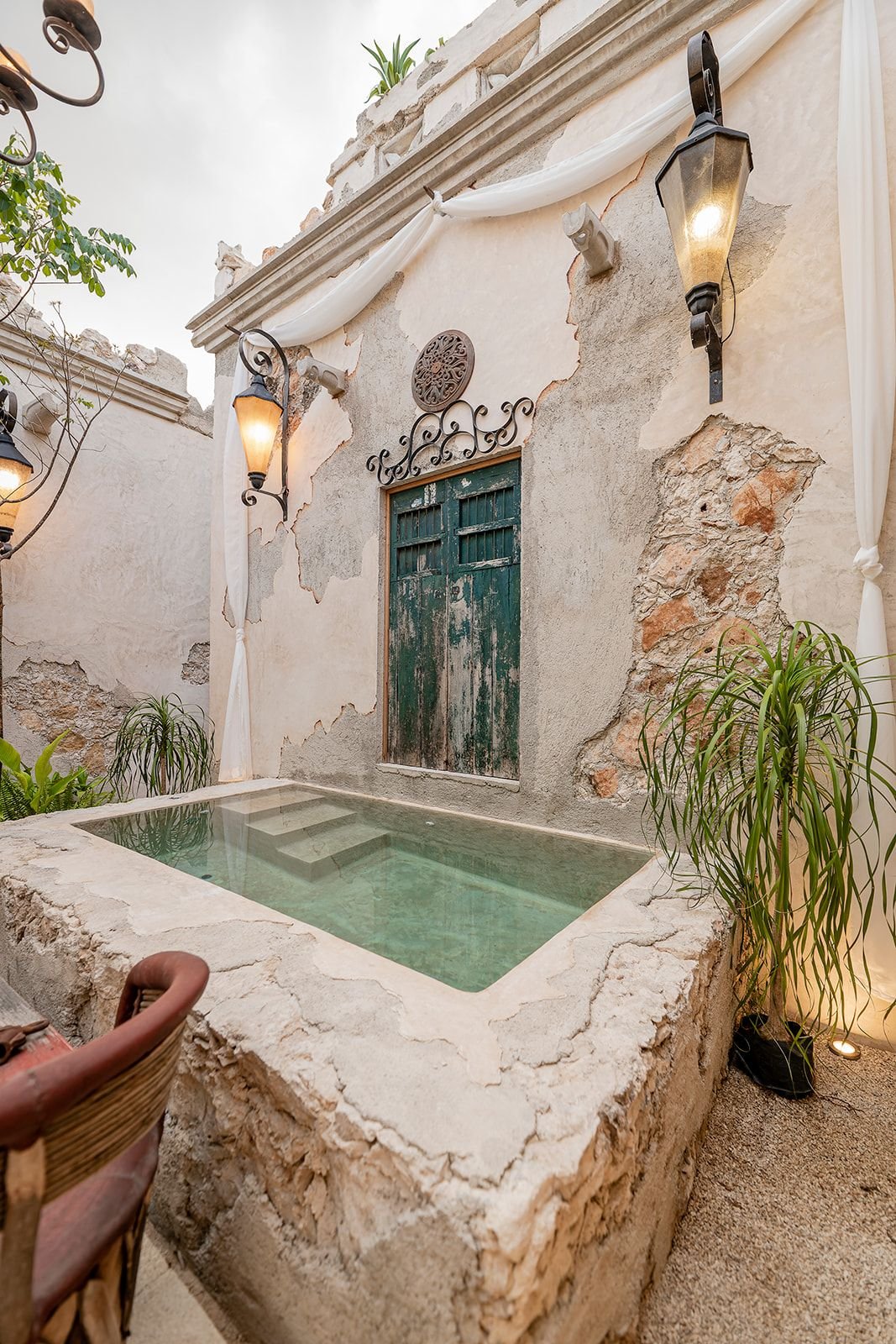
A plunge pool bordered by natural stone — flagstone, travertine, or limestone — has the feel of a hidden swimming hole discovered off a quiet country track.
Organic edges. Warm, earthy tones. Maybe a little creeping plant threading through the gaps.
This look belongs in cottage gardens, Mediterranean-style properties, and rural homes where a clean concrete rectangle would feel entirely at odds with the setting.
Natural stone also stays more comfortable underfoot in direct sunlight than darker paving materials tend to.
It’s the kind of feature that grows on people quietly. Understated beauty often has the longest-lasting impact.
Bring the look together with landscaping rocks in earthy natural tones and vertical garden planters against the fence. Add chaise lounges nearby for a comfortable place to relax once you’re done soaking.
2. The Plunge Pool With a Built-In Sitting Ledge
A surprisingly common design oversight: building a plunge pool with nowhere comfortable to sit once you’re actually in it.
You step in. You stand there. Maybe you crouch awkwardly. It doesn’t feel quite right.
An integrated underwater bench along one or both walls resolves this beautifully. It gives you a genuine spot to settle, and it creates a shallower section that works well for children or guests who prefer not to be in deep water.
Some people opt for an L-shaped bench, essentially building a social seating area within the pool itself.
Imagine sitting there on a warm evening, water rising to your chest, something cold in hand. That’s not an indulgence. It’s a thoughtful, practical improvement that costs less than most people expect.
Complement the setup with an in-pool stool for edge seating, a striped indoor/outdoor rug to define the deck space, and a couple of patio side tables to keep drinks and essentials close by.
3. The Freeform Plunge Pool With Lush Tropical Plants
Not every plunge pool needs to follow a grid. Some of the most beautiful ones don’t.
A freeform shape — gently curved, kidney-shaped, or completely organic — surrounded by lush tropical planting creates a space that feels more like a private resort than a backyard.
Palms. Birds of paradise. Broad-leaved philodendrons. A few strategically placed boulders.
It’s pure escapism in your own yard. Open the back door and you’re somewhere else entirely.
Curved forms also help smaller yards feel more generous visually. Organic lines read as more spacious than right angles tend to.
If your home already has a tropical or coastal character, this style will look like it was always meant to be there.
Frame the space with areca palm trees and a cedar vertical garden along the boundary. Hang outdoor globe string lights overhead so the mood carries comfortably into the evening.
4. The Raised Concrete Plunge Pool
Struggling with a yard that slopes? This design was made for that exact situation.
Instead of digging down and dealing with drainage headaches, a raised concrete plunge pool sits partially or fully above the existing ground level. The result looks clean and modern — almost like a piece of outdoor architecture.
Finish the exterior in stacked stone, smooth render, or timber cladding to match whatever surrounds it.
The built-in bonus? The raised walls become natural informal seating. Guests rest on the edge. Children sit with their feet in the water. You set your glass on the rim during a soak.
Something to consider on cost: if your ground drops away from the house, a raised pool can sometimes cost less to build because heavy excavation becomes unnecessary.
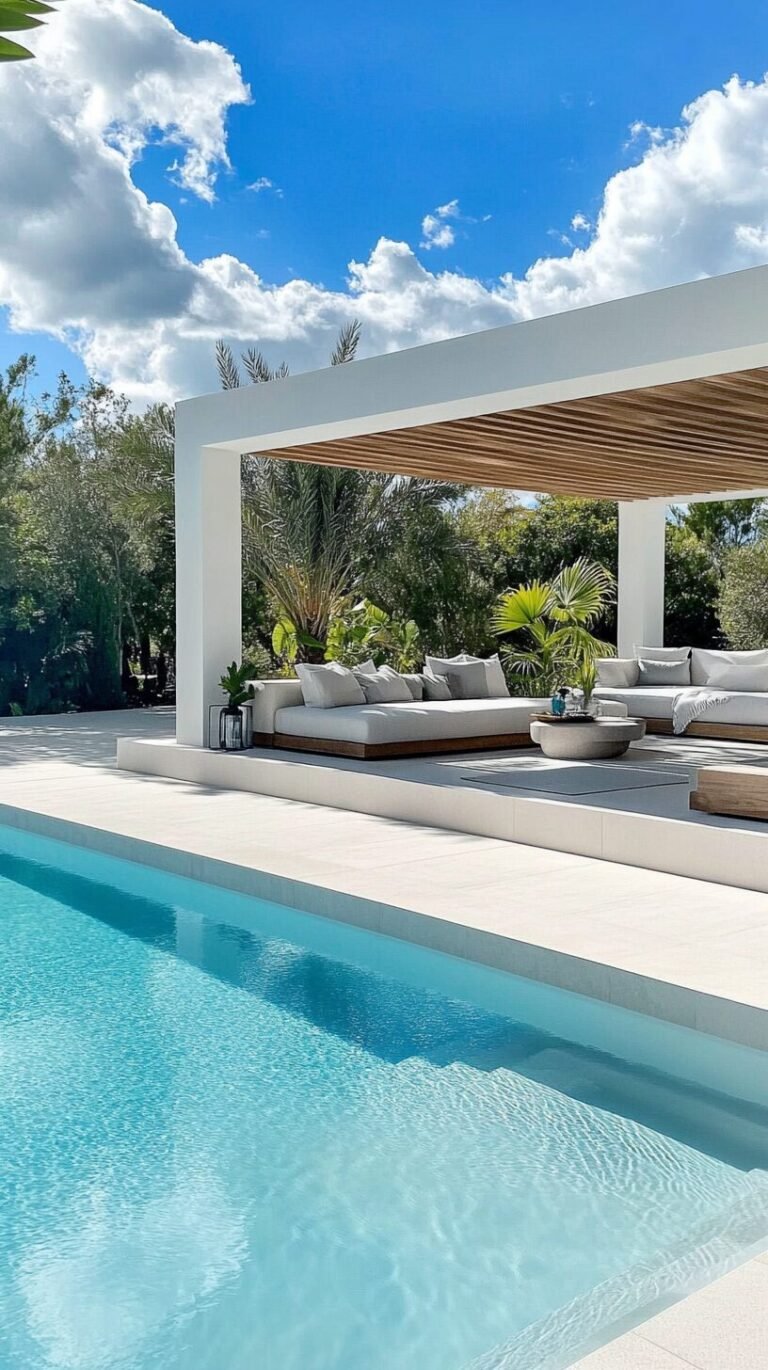
A louvered aluminum pergola beside the pool adds shelter and gives the whole area the feel of a defined outdoor room. An indoor/outdoor area rug in the seating zone pulls the space together visually.
5. The Plunge Pool Woven Into a Deck
This is the layout that earns magazine spreads — and it deserves every one of them.
A timber or composite deck wraps smoothly around the pool until the water feels like it’s part of the living space itself. You step off the deck and directly into the pool. No awkward transition zone. No clunky edge treatment.
The deck serves simultaneously as lounge area, dining space, and pool surround.
The essential ingredient is a flush rim. Pool edge level with deck surface. Everything merging into one clean horizontal plane.
Even a modest backyard can feel considerably more expansive with this approach. It’s not a visual trick so much as a genuine spatial transformation.
A safety note worth taking seriously: choose textured, slip-resistant decking near the water. Smooth composite boards and wet feet are an accident that happens only once before you wish you’d planned ahead.
Arrange teak pool chaise lounges on the deck and hang a shade sail overhead. A concrete-look outdoor side table between the loungers keeps everything close and the space feeling thoughtfully organized.
6. The Cocktail Plunge Pool Fitted With Jets
If you want a plunge pool that does double duty, this one is worth a close look.
A cocktail pool — sometimes called a “spool” because it blends spa and pool — marries the compact size of a plunge pool with hydrotherapy jets, temperature control, and sometimes a warmer section at one end.
A cooling dip in summer. A warming therapeutic soak in winter. One installation that earns its keep year-round.
If you live somewhere with genuine cold winters, this design might be the most practical choice on the entire list. You’ll actually use it in January instead of looking at it through the window.
Most run around 10 to 12 feet in length — perfectly comfortable in the vast majority of residential yards.
Set up a large cantilever umbrella for shade and keep reclining chaise lounges nearby for easy transitions from the water. String outdoor string lights overhead to keep the relaxed mood going after sundown.
7. The Glass-Paneled Plunge Pool
This design is for those who want their backyard to genuinely surprise people.
A plunge pool with one or more clear acrylic walls allows you to view the water from outside. It’s theatrical, entirely unexpected, and turns the pool into a piece of living art.
Glass-panel pools look most striking when raised or semi-raised, with the transparent face toward a seating area or garden path.
Come evening, with underwater LED lighting illuminating the water from inside, the effect is quietly spectacular.
Yes, it costs more. Yes, it requires engineering-grade acrylic and careful structural work. That part is simply true.
But if you want the kind of backyard that stops first-time visitors mid-step — this is the design that does it.
8. The Japanese-Inspired Deep Soaking Pool
For those who are drawn to calm and simplicity, this one will resonate.
A clean, rectangular basin. Dark natural stone or tile. Possibly a single bamboo spout carrying a gentle, continuous stream across the water.
Japanese soaking pools have a long and considered history. They emphasize depth rather than surface area, so you can sit shoulder-deep in a pool that’s only 7 feet across.
Surround the basin with raked pebbles, ornamental grasses, and a simple timber screen to create privacy without visual noise.
The result doesn’t feel like a backyard project. It feels like a spa that somehow always belonged there.
A useful note: dark tile holds solar warmth effectively. In milder climates, that can mean the water stays comfortable with minimal mechanical heating, which shows up noticeably in your energy costs over time.
9. The Courtyard Plunge Pool
Have a narrow side passage or a walled courtyard that’s going to waste? Take another look at it.
Some of the most remarkable plunge pool builds happen in spaces that homeowners had mentally written off before they started.
A slim pool — perhaps 5 feet across and 12 feet long — can turn a forgotten gap between your house and the fence into a genuinely peaceful retreat.
Add a vertical garden on the fence, warm lights strung above, and two loungers placed alongside.
What was once dead space becomes the most-used spot in the entire property.
This configuration is especially popular with townhouse owners and terrace-home residents for whom a standard pool simply isn’t a possibility.
The best solutions are often born from limitations. It happens reliably.
Common Errors That Stall Plunge Pool Projects
Before you make any calls or commitments, it’s worth knowing where these projects tend to go sideways.
Because they do. With surprising regularity.
Error 1: Skipping the permit process.
It’s easy to assume that something as small as a plunge pool doesn’t need formal council approval. In most places, any permanent in-ground water structure requires a building permit. Skip this step and you’re exposed to fines, compulsory demolition, and issues when you eventually sell the property.
Check with your local authority before you do anything else.
Error 2: Overlooking drainage design.
Water displaced by bodies entering the pool has to go somewhere. Without proper overflow management and site grading, it goes where you don’t want it — toward foundations, neighboring properties, or garden beds.
Get drainage right from the start of the design process.
Error 3: Underinvesting in filtration.
Smaller water volume means that chemistry changes happen fast and dramatically. A small imbalance can turn into a green, unswimmable mess in a matter of days.
Invest appropriately in a quality filtration and sanitation system that matches your pool’s specific size. This is genuinely not somewhere to save money.
Error 4: Forgetting shade coverage.
A plunge pool sitting in unbroken sun all afternoon heats up significantly by midsummer. Sitting in warm water when the air is already hot is uncomfortable, not refreshing.
Plan proper shade from the outset — a shade sail, pergola, or large umbrella will make a genuine difference to how much you actually use the pool.
Choosing the Design That Makes Sense for You
If the options feel a little overwhelming, simplify the decision with a few honest questions.
One: How much space do you actually have? Measure the area properly — don’t guess.
Two: How do you genuinely plan to use the pool? Quick refreshment? Social entertaining? Year-round therapeutic soaking? Your honest answer shapes everything else.
Three: What does your property already look like? The right pool design will feel like it belongs there. A mismatched style will always feel slightly wrong, no matter how well it’s built.
Be honest with all three questions and the right choice tends to become quite clear.
Your Backyard Has Been Waiting for Something Worth Your Time
Think about how many hours you spend at home. It’s probably more than you realize.
Yet many people treat the outdoor space like an afterthought — somewhere for the bins and a bit of grass for the dog.
A plunge pool invites you back outside.
It gives you something to look forward to when you get home. A place to slow down, to host people comfortably, to genuinely enjoy the property you’ve invested in.
You don’t need an enormous yard. You don’t need a famous builder. You don’t need an intimidating budget.
You need a solid, realistic plan, a design suited to your actual space, and the decision to stop planning and start acting.
Your backyard is patient. But it’s ready when you are.