27 Chair Design Secrets Designers Use to Make Living Rooms Look Expensive
Disclosure : This post may contain affiliate links or paid partnerships. I may earn compensation if you click a link or make a purchase, at no additional cost to you. See my disclosure for more info.
You’ve done everything the design blogs recommended.
Statement rug. Gallery wall. Layered lighting. Plants that somehow survive indoors.
The living room still looks… fine. Generic. Like a showroom floor, but less curated.
Something is still missing.
Here’s what professional designers know that most homeowners never figure out:
The chairs do more work than almost anything else in the room. They define scale. They create conversation. They communicate whether a space was designed or simply furnished.
Not the sofa. Not the art. The chairs.
And most of us treat them as an afterthought — a practical solution to the problem of “more people need somewhere to sit.”
These twenty-seven tips are what professional designers actually apply when they want a living room to read as expensive, considered, and complete.
Use even a handful of them this weekend and the difference will be visible.
Scale and Structure: Getting the Bones Right
1. Measure the room’s footprint before choosing any chair.
Designers never select furniture from a screen alone. They bring the dimensions of the room to every decision.
A chair that reads as sleek and proportionate in a designer’s 3,000-square-foot studio becomes visually oppressive in a standard apartment living room. Tape the dimensions on the floor before you order. Walk around the outline. Check it from the doorway. Then decide.
2. Counterbalance sharp geometry with at least one curved form.
A room built entirely from right angles — boxy sofa, rectangular shelving, square coffee table — creates a kind of visual rigidity that people feel without being able to name.
One chair with a rounded form or curved back breaks the tension. The room softens without a single other element changing.
3. Lower the chair height to gain the illusion of ceiling height.
This is a classic spatial trick. Low-profile seating widens the perceived gap between furniture and ceiling, making the room read as taller than it actually measures. In rooms with eight-foot ceilings, this is one of the most effective tools available.
4. Choose legs that let the floor breathe.
Exposed-leg chairs — tapered wood, thin metal, hairpin forms — create visual openness by revealing the floor beneath them.
Fully skirted or solid-base chairs block floor visibility and compress the room. The footprint is identical. The spatial feeling is not.
5. Use one oversized chair as the room’s compositional anchor.
Designers often include one deliberately generous piece — a broad wingback, a deep-seated club chair — to create a visual anchor point. The distinction between this and a scale mistake is intentionality. The chair was chosen for the room. The room was considered around the chair.
Color and Material: The Professional’s Palette
6. Intentionally contrast your chairs against your sofa.
Matching upholstery across a seating group is what happens when someone avoids making a decision.
Professional designers almost never do this. They use contrast — a darker chair against a lighter sofa, a warm tone against a cool neutral — to generate visual interest and suggest that the room was put together with care.
7. Use texture variation instead of color contrast if your palette is neutral.
Not every project calls for a bold accent chair. Many designers work almost entirely in neutrals.
But a bouclé piece next to a smooth linen sofa? A velvet seat beside woven cotton?
Texture creates depth the same way color does. The palette stays calm. The room stays rich.
8. Specify performance fabric in high-use spaces.
Designer showrooms look immaculate partly because no one actually lives in them.
In a real home, with real occupants, performance upholstery is a professional-grade choice — not a compromise. Crypton, Sunbrella, and similar fabrics resist staining without looking utilitarian. They let the room maintain its appearance through actual use.
9. Install one deliberate color accent in the seating arrangement.
One chair. One color that commits. Deep olive. Aged brass yellow. Inky blue-green.
Against a restrained background, this single accent piece becomes the element the room is organized around. It communicates design conviction. Visitors may not be able to articulate why the room works. This chair is often why.
10. Include at least one leather piece for warmth and longevity.
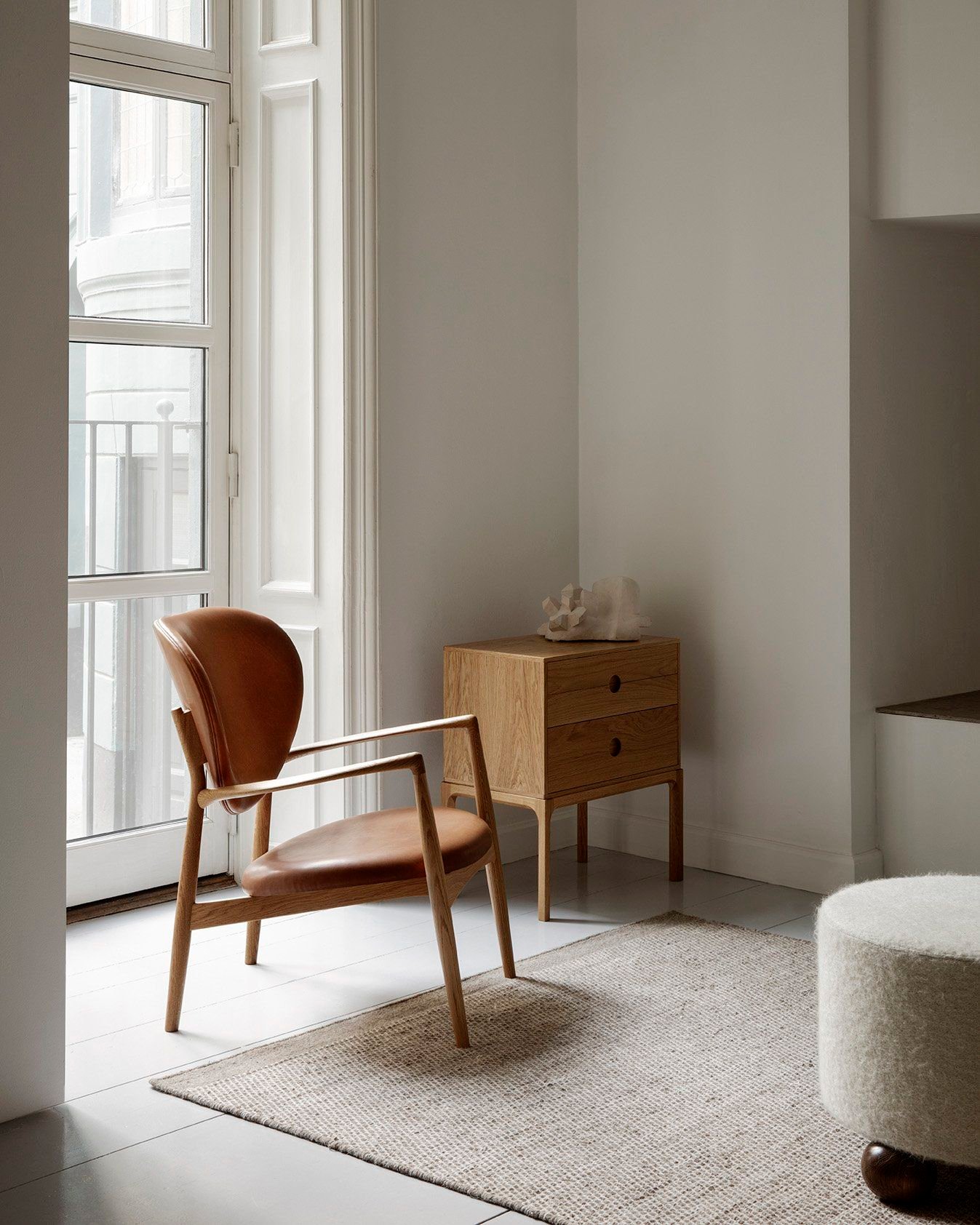
A leather chair in cognac, chestnut, or deep espresso introduces organic warmth that softened synthetic materials rarely match.
And leather is unique in that it improves through use. Patina is the goal, not a side effect. Few other materials can make that claim.
11. Evaluate the back of the chair, not just the seat.
Professional designers always review a piece from multiple angles before specifying it.
If the chair will float in the room — away from any wall — its back will be seen constantly. Detailing on the rear panel — tufting, carved wood, exposed joinery — makes the chair a visual asset from every direction.
Placement Strategy: How Designers Arrange a Room
12. Pull all seating at least eight to twelve inches from the walls.
This is one of the first corrections a professional makes in any room.
Furniture pressed against the walls creates an empty center and a room that reads as unfurnished, regardless of what’s in it. Pulling pieces forward creates a seating group — a destination — with spatial intention.
13. Set accent chairs on a diagonal facing the primary seating.
Thirty to forty-five degrees relative to the sofa creates a natural conversation triangle. Designers use this geometry to make rooms feel social and inviting without adding any additional furniture.
14. Build a reading corner with one chair, one table, one lamp.
A side table, a floor lamp, and one good chair establish a distinct zone within the larger room. That zone gives the room programmatic depth. It suggests the space was designed for how life is actually lived inside it.
15. Anchor a fireplace by flanking it symmetrically.
Two matching chairs — one on each side of the firebox — is a compositional move that has defined formal living rooms for centuries. Symmetry reads as stability and intention. Even modest fireplaces gain architectural presence when properly framed.
16. Define zone boundaries in open-plan layouts with chair placement.
A single chair at the outer edge of the seating group functions as a zone marker — a soft boundary between living and dining, or between conversation and circulation. No walls, no room dividers, no rugs required.
17. Position your most comfortable chair toward the room’s best feature.
A window view. A private garden. The corner where afternoon light gathers longest.
That spot is where the best chair goes. Comfort directed toward beauty is the combination that makes a room worth inhabiting rather than just admiring.
Finishing Details That Elevate the Whole Piece
18. Replace standard-issue legs with something more considered.
This is arguably the single highest-return intervention on this list.
Stock chairs from accessible price points almost always come with generic legs. Swap them. Walnut tapers. Polished brass caps. Matte black pin legs. The change takes minutes, costs almost nothing, and shifts the perceived price point of the chair substantially upward.
19. Use one lumbar pillow with material contrast.
One pillow. Not more. A lumbar throw that complements but doesn’t match — a textured weave on a smooth upholstery, velvet on linen — adds layering and comfort in equal measure. It looks considered without looking overdressed.
20. Prioritize chairs with visible artisanal details.
Nail-head borders. Exposed hardwood frames. Hand-stitched seams. Brass tack work.
These elements suggest investment and craft. The room absorbs that quality — chairs with fine detail make everything around them read slightly better.
21. Let at least one chair have a truly distinctive silhouette.
Beyond the standard rectangle-plus-cushion form, there is a rich library of chair shapes with genuine sculptural presence. A pod form. A wishbone frame. A continuous curved back. When one chair reads as an object with its own character, the room gains a layer of visual interest that no amount of accessories can replicate.
Functional Choices That Make Real Rooms Work
22. Specify a swivel base for multi-use living rooms.
A swivel chair adapts to the room’s current activity without moving an inch. Toward the TV. Toward the conversation. Toward the window. Toward the kitchen if someone’s talking from it.
For living rooms that serve multiple daily functions, this is the most genuinely versatile seating form available.
23. Add an ottoman to complete the chair’s purpose.
Alone, the chair offers a place to sit. Paired with an ottoman, it offers a place to genuinely relax.
The pairing also expands visual mass and weight in a room without adding another piece of primary furniture.
24. Drape a throw over the chair arm before any guests arrive.
A casually draped throw signals that the room is used and loved, not staged and untouchable. It adds warmth and texture to the chair with almost no effort. Three seconds. Genuinely.
Choices That Quietly Undermine a Beautiful Room
25. Only invest in chairs that work as actual seating.
Acrylic. Certain pressed-wood forms. Chairs that look important but offer nothing to a person who sits in them for any length of time.
If the chair couldn’t carry a full evening of guests, it doesn’t belong in the primary seating arrangement. A decorative piece that functions only decoratively is a display item. Your living room is a room for living.
26. Verify seat depth fits your body before committing to a purchase.
Too deep: you slide forward or pile cushions behind you to maintain posture. Too shallow: it feels temporary, not restful. Sit all the way back. Your feet should rest flat on the floor. If they don’t, the depth is wrong — particularly significant for anyone on the shorter side of average height.
27. Introduce seasonal rotation to prevent the room from stagnating.
No new furniture required. Swap a weighted leather armchair for a rattan accent piece in warmer months. Bring in velvet and heavier textiles when the temperature falls.
The room evolves with the calendar. It stays visually fresh. And the cost of the rotation is minimal.
The Real Reason This Works
Designers know what most homeowners don’t: the chair is the decision that holds everything else in the room together.
Not the sofa. Not the rug. Not the lighting scheme.
The chairs are what guests see from the doorway. The chairs are where people settle in. The chairs are what give a room its sense of purpose and proportion.
They deserve deliberate choices.
You don’t need professional fees or a large renovation budget. You need to treat chair selection with the same care you’d give any other significant design decision.
Start with one of these tips. Apply it this weekend.
Add another the following week.
The room will respond faster than you expect. That’s the part designers already knew.